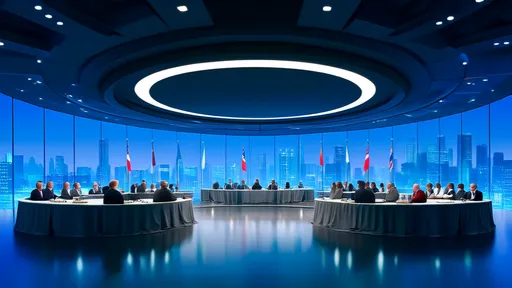
The global trading landscape is on the cusp of a profound transformation as member nations of the World Trade Organization (WTO) officially commence negotiations on a comprehensive reform package. This initiative, long debated in corridors of power and international forums, has now moved into a decisive phase, signaling a collective acknowledgment that the architecture governing world trade must evolve to meet contemporary challenges. The launch of these talks represents not merely a procedural step, but a critical juncture for the future of economic cooperation, supply chain resilience, and the very principles that have underpinned multilateralism for decades.
At the heart of these discussions lies a recognition that the WTO, established in 1995 as the successor to the General Agreement on Tariffs and Trade (GATT), is struggling to remain effective in a world markedly different from the one it was designed to serve. The rapid ascent of digital commerce, the urgent imperatives of climate change and sustainability, and the stark geopolitical fissures that have emerged in recent years have exposed significant gaps and inefficiencies within the existing framework. The reform agenda is therefore sprawling and complex, aiming to modernize rules, improve the effectiveness of the dispute settlement system, and enhance the organization's ability to facilitate negotiations among its 164 diverse members.
The most immediate and politically charged issue is the reform of the Appellate Body, the WTO's top dispute settlement court, which has been effectively paralyzed since late 2019. The United States, under multiple administrations, has blocked the appointment of new judges, citing judicial overreach and concerns about the body's interpretation of WTO rules. This stalemate has created a crisis of credibility for the organization's enforcement mechanism, leaving trade disputes in limbo and weakening the deterrent against protectionism. Finding a solution that addresses these concerns while preserving an independent and binding two-tier dispute system is perhaps the single greatest test for the current negotiations.
Beyond dispute settlement, member states are grappling with how to write new rulebooks for the 21st-century economy. Digital trade is a frontier where existing agreements are largely silent. Negotiators are now tasked with crafting disciplines on data flows, data localization, digital privacy, and the moratorium on customs duties for electronic transmissions. Similarly, the intersection of trade and environmental sustainability is gaining unprecedented prominence. Debates are intensifying around how WTO rules can support, rather than hinder, climate goals—for instance, by aligning with the Paris Agreement or facilitating trade in environmental goods and services.
Another thorny set of issues revolves around special and differential treatment for developing countries. The original WTO agreements contained provisions allowing poorer nations more flexibility and longer timeframes to implement commitments. However, the dramatic economic growth of countries like China, India, and Brazil has led some developed economies to argue that the self-designation system is outdated and allows large, competitive economies to avoid making fuller contributions. Reaching a consensus on how to define development in the modern context, and what responsibilities come with different levels of economic advancement, will be a diplomatic minefield.
The very process of negotiation within the WTO is also under scrutiny. The organization traditionally operates on the principle of consensus, where any single member can block an agreement. While this ensures that decisions have broad buy-in, it has also made concluding complex multilateral rounds nearly impossible, as evidenced by the long-stalled Doha Development Agenda. In response, there is growing momentum for "plurilateral" approaches, where groups of like-minded countries negotiate agreements on specific topics within the WTO framework. These agreements are then open for others to join, creating a more flexible and potentially more productive path to making new rules.
The geopolitical backdrop against which these talks are occurring cannot be overstated. Rising tensions between major powers, particularly the United States and China, have spilled over into trade policy, characterized by tariffs, sanctions, and a push for "friend-shoring" supply chains. This great-power competition threatens to fragment the global trading system into competing blocs. A central question for the WTO reform process is whether it can create a sufficiently robust and adaptable framework to manage these tensions, prevent a full-scale decoupling, and maintain a platform for cooperation even among strategic rivals.
For the business community, the stakes are enormous. A successful reform that strengthens dispute resolution, provides clarity on new issues like digital trade, and reduces policy uncertainty would be a significant boon for global investment and cross-border commerce. Conversely, a failure to achieve meaningful reform could accelerate the trend towards bilateralism and regionalism, forcing companies to navigate a more fragmented and potentially contradictory web of trade rules, increasing costs and complicating logistics.
In conclusion, the launch of the WTO reform negotiations is a moment of both great peril and great promise. The path ahead is fraught with political difficulty and technical complexity. Success is far from guaranteed. Yet, the alternative—a weakened, irrelevant WTO and a descent into outright protectionism and trade conflict—is a outcome too costly for the global economy to bear. The world is watching to see if its nations can summon the political will to forge a new consensus and reshape the multilateral trading system for a new era.
By /Sep 16, 2025

By /Sep 16, 2025
By /Sep 16, 2025

By /Sep 16, 2025
By /Sep 16, 2025
By /Sep 16, 2025

By /Sep 16, 2025

By /Sep 16, 2025

By /Sep 16, 2025

By /Sep 16, 2025

By /Sep 16, 2025

By /Sep 16, 2025
By /Sep 16, 2025

By /Sep 16, 2025

By /Sep 16, 2025
By /Sep 16, 2025

By /Sep 16, 2025

By /Sep 16, 2025

By /Sep 16, 2025

By /Sep 16, 2025